The dose makes the poison.
The classic question posed to coaches by wide-eyed athletes, weekend warriors and those new to exercise: how much should I be training? Some hope for little, some hope for lots, but all want a definitive answer. I'm not going to fob you off with “it depends”, even though it's true. Here are some principles to guide your thinking and narrow in on what's right for you or your athlete.
The short version: more training gets you more results and faster results, but carries more risk. Too little training gets no results. The sweet spot is where you get fitter, and within that you make a call on risk versus patience. Regularly evaluate your progress to determine where you are relative to the sweet spot, and course correct.
Enough
When does too little become enough become too much? Two concepts matter: Minimum Effective Dose (MED) and Maximum Recoverable Volume (MRV).
MED is the amount of training required to actually move forward. Eliud Kipchoge isn't going to improve his marathon time running 1km a day at an easy pace. Equally, Dave down the gym isn't getting bigger biceps from the same three sets of ten curls at 8kg he's done for four years. The body requires stress to stimulate adaptation. Without enough of it, there's no business case for your body to adapt.
MRV is the opposite end: the most training your body can handle and actually repair from in time to train again. Beyond it you're slowing your own progress. This is Jonny Wilkinson practising goal kicks until he tore his adductor and couldn't kick for weeks. There's a physiological limit to how much and how quickly we repair, affected by training history, injury history, movement quality and lifestyle. Exceed it and, at best, recovery takes longer; at worst, you get seriously injured.
The sweet spot
Between MED and MRV is the sweet spot, and it isn't constant. The fitter you are, the more you need to do to exceed MED, and the more you can do before breaching MRV.
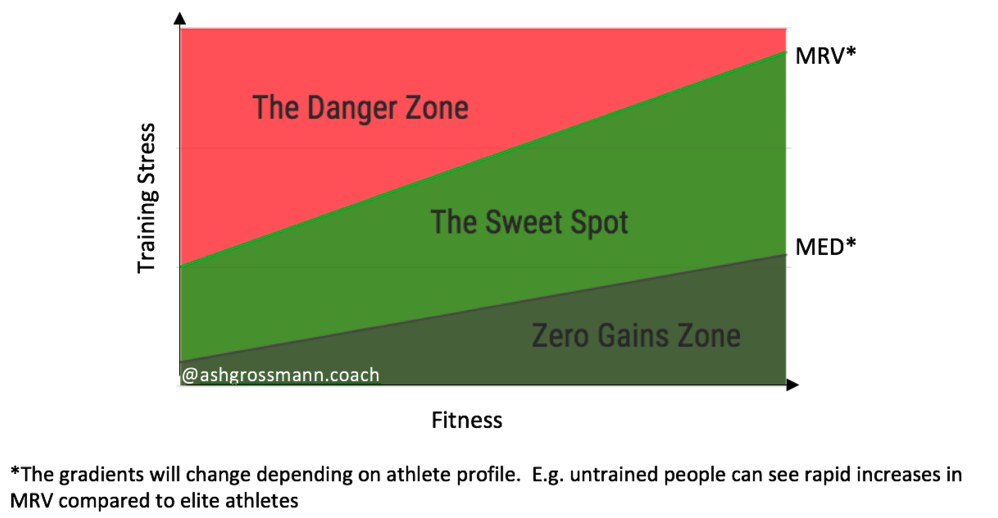
The nuance: the more training you do, the faster the results, but the closer you sit to MRV and the danger zone. So there's a decision to make.
- Competitive athlete: flirting with MRV is where you need to be. It isn't enough to improve; you need to improve faster than the competition. Higher risk, higher reward.
- Impatient for results: decide your risk appetite. How soon do you want results, and what are you willing to sacrifice in time, cost, effort and injury risk?
- In no rush: just make sure you're over MED and progressing, however slowly. Kick the tyres now and again.
Making it practical
Think of training stress as volume times intensity: reps times weight, or distance times speed. Running 100km a month at 7.00/km with 1,000 air squats is very different to 100km at 3.30/km with 1,000 back squats at 100kg. Endurance athletes will know Training Stress Scores; for a light-touch approach, hours times effort is your starting point.
Then assess your progress. Are you getting fitter in the way you want? If not, why not? Are you closer to MRV or MED? If you're on track, keep going. If not, course correct: train more, train less, train smarter, or fix your recovery. Training stress is the first port of call.
Final thoughts
The human body can adapt to almost anything if the rate of change is right. More is always more, but sometimes it's too much. If you have no idea where your training stress sits, you probably stand to benefit from thinking about it.