I often get asked what a Muscle Imbalance Assessment is, so I thought I'd write a quick blog on it. Hopefully it gives some insight into how it works, outlines some areas for improvement in your own training, or gives some structure around how you view movement and biomechanics.
The majority of people booking in for an assessment are experiencing pain or a niggle that just isn't going away. They've usually tried traditional healthcare options with no joy, and are frustrated that their training is suffering as a result. Sometimes they've noticed a major asymmetry in their movement, or where they feel sore after training, and want to get ahead of it. Or they've plateaued in a certain movement and are struggling to make progress despite ramping up their training: three different squat programmes, same 1RM. These are all great reasons to have an assessment.
Step 1: the pain picture
Every assessment is different. The key consideration is what exactly is causing the pain: establishing the specific movements that trigger it and the circumstances around it. Is a back squat worse than an overhead squat? Is strict pressing a problem, but push pressing fine? Does running fast feel okay but long slow plods hurt? Maybe the pain is worst when you wake up, then eases off as you warm up into training. Questions like this give a lot of clues as to what the type of issue might be.
Step 2: history
Next we chat history: sport, training and injury history specifically. Usually there are some big clues as to what the root cause might have been. Years of playing a one-sided sport. Being in a cast for several months and avoiding loading a limb. A job that keeps you in one position for long periods. The body is incredibly adaptive and will form movement habits to respond to whatever it thinks you need; unfortunately this isn't always aligned with what you want it to do.
Step 3: current training
Before we even look at the body, we talk current training. What are you working towards? Did any changes in your programme, routine or lifestyle precede the issue? The body can adapt to almost anything if the rate of progression is appropriate, so considering training volume, both overall and for specific movements, is crucial. Knowing your goals also shapes the programme design: rehabbing a knee for squatting is different to rehabbing a knee for running, even if the injury is the same.
Step 4: the movement assessment
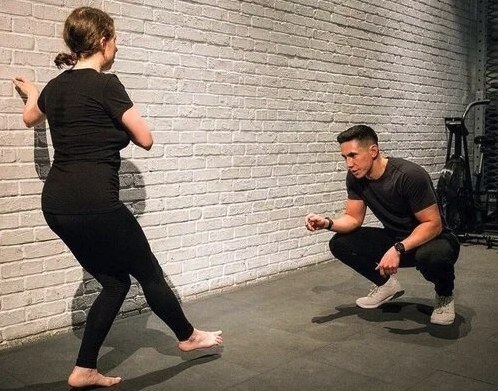
Finally, we look at the body. Depending on what the consultation established, we look at the fundamental movement qualities related to the issue: mobility, stability and functional control. In simpler terms, can you use the mobility and stability in the movement that matters? It's possible to have good mobility and stability in isolated tests but not in the actual exercise that hurts, so the assessment has to reflect the context where the issue arises. You can “activate” your glute in an isolated test like a glute bridge (which I'll never ask you to do), but it doesn't seem to fire when you deadlift or run. Context is everything.
Step 5: plugging the gaps
Once we've built a picture of where the movement gaps are, we design exercises to plug them. We play with directions, ranges of motion, points of stability and loading options to give your body the best environment to learn the skills it currently lacks. This is where silly lunges come into play: the odd-looking exercises are specifically targeting a movement quality your body needs to improve. It could be as simple as stretching a muscle to create more range, or as complicated as stabilising a lazy muscle in one plane while tweaking an overactive muscle in two.
We film the exercises with instructions so you can refer back and keep form correct without me; the subtle tweaks make a big difference. Then it all goes into a programme that fits your training schedule and lifestyle. Over the following weeks we stay in touch to review progress and advance the exercises, making sure you see the improvement in performance or reduction in pain you came for.
Thanks for reading if you've got this far. Ready to book one? Everything you need is here. Any questions about the process, don't hesitate to get in touch.